On Being Blog

9 comments

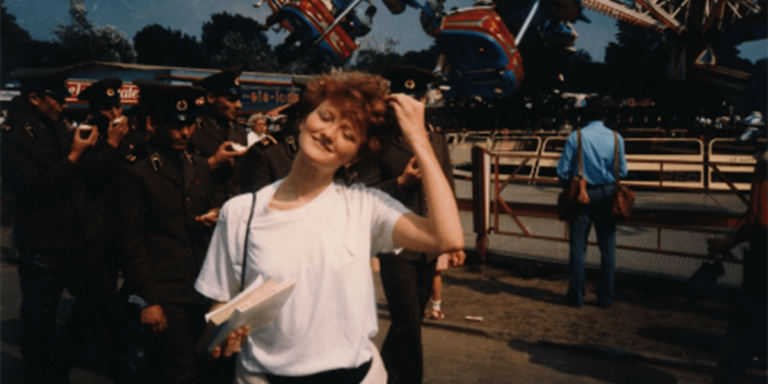
"I picked up a camera in journalism class, and it was truly spiritual."

The 55-year-old photographer Ann Marsden passed away last night after a protracted battle with cervical cancer. We've had the honor of working with her many times over the years. Her passion for her craft inspired all of us at On Being, and we’ll miss her deeply.

Ms. Marsden should have the last word. Be sure and watch the video above as she describes her own creative process and off-angle approach to photographing and seeing the world.

6 comments

Somehow, this Higgs boson infatuation will get the better of me and I'll just stop trying to understand the complexity of it all. Until that day comes, I'll be watching great explainers like this one. The artist's comic sketches and way quantum physics is animated get me closer... I think.

The cast of "Saving Aimee" performs "Such a Time as This" at Seattle's 5th Avenue Theater in 2011.

The recent, unexpected success of the Tony Award-winning musical The Book of Mormon opened up the sphere of religion to the world of entertainment. If Kathie Lee Gifford has her way, Pentecostal preacher Aimee Semple McPherson will be the next historical religious figure to make it to Broadway. According to an equity casting notice for The Aimee Project, Ms. Gifford wrote the book (for you theater neophytes, the script) and lyrics, with the show tentatively scheduled to open on Broadway in fall 2012.

In the radio show "Reviving Sister Aimee," Krista Tippett describes the trailblazing evangelist as the "closest thing the early 20th century may have had to Oprah Winfrey." Aimee Semple McPherson was the first woman to get an FCC license, which she used to bring her Christian message to the radio airwaves. Audiences came out in droves for her theatrical sermons filled with costumes and props — she was almost a musical in the making. And, if the musical is anything like those revivals she held in Angelus Temple, it ought to be something beyond soul-stirring.

138 comments

Let's make no mistake here; this is a commercial for Banco Sabadell. And, yes, it's a majestic, highly orchestrated flashmob organized by one of Spain's largest banking groups. But, when I get an evening email from our founder and host confessing to shedding "happy tears" when watching it, I figure I better check it out.

Flashmob organizado por Banco SabadellAnd, if you read the comments on YouTube, you'll see much more of the same sentiment being expressed.

On May 19th at six in the evening, what appeared to be a single, tuxedoed street performer playing a bass for people strolling around Plaça de Sant Roc in Sabadell, Spain (just north of Barcelona) turned into a mass ensemble performing a movement of Beethoven's Ninth Symphony — including more than 100 musicians and singers from the Orchestra Simfònica del Vallès, Amics de l’Òpera de Sabadell, Coral Belles Arts, and Cor Lieder Camera.

The production is lovely and highly produced, but it's the fascination and pure joy of the passersby that makes the moment quite magical. Non?

11 comments

Minaret in Israel

When I lived in Israel, the air felt denser, heavier. In such a small space, words (and worlds) piled up with such intensity, you felt yourself using muscles you didn't know you had, straining to make sense of all the war and death and beauty contained in the land.

I think that is why, years later, when I finally read the Psalms, the word selah held such meaning for me. Its original definition is unknown, but there is some agreement that selah signifies a moment of reflection, an invitation to "weigh" or "measure" the singer's words.

For me, selah is a prayer within a prayer. It means "may the ears hear and the eyes see." It is a word that asks us to stop and listen, really listen, to the song.

On this, first morning of my life,
hosannas are not enough.

I walk and walk,

up streets with Jewish names,
down streets with Arab names —

all in celebration of great poets
or killers.

Men who were both poets and killers.
May my pen draw blood and pour wine.

I walk through old monuments,
tombs of alabaster, car soot.

Slogans half hid
behind green bombs of melon,

grenades of black and purple grapes.

In the end, who will history anoint?
I forget who was Isaac, who Ishmael.

I walk and walk,
forgetting my own language, my alphabet,

the one carried by Phoenicians
from port to port —

trading letters aleph bet

that were rounded like stones
by a lapidist alif ba

and passed from mouth to mouth
until they lost all but essence a b

and continue to be worn and smoothed,
until, as jewels,

only their memory is left —

as I limp through harbours,
the bilge of refugees —

in this, last moment of the day,

when the sky burns purple
and the ocean breaks black,

when the streetlamps tremble and,
all around,

the noise of guns and worship —

Selah. Enough.


A.E. LeftonA.E. Lefton is a poet, journalist, and educator currently living in London. You can read more of her writings on her blog, All I Own I Carry.


2 comments

Photo Op of Mitt Romney in IowaPresidential candidate in Des Moines, Iowa on December 30, 2011. (Photo by Mike Hiatt/Flick, licensed under Creative Commons)

In Wednesday's Religion Dispatches, Joanna Brooks describes how journalists report on Romney's business history with vigor, and treat his "faith" as an ethnicity. I think she's describing the disconnect between the spaces in which we live and the way we've publicly lived religion since the 60's — and that this has fermented many of our current domestic crises.

"I’m waiting for the story that transcends the flat ethnicity paradigm and gets the deeper and more persistent question of religion and moral bearings:

How does the most religiously devout candidate in recent memory reconcile a life of religious commitment with a values-neutral approach to work, livelihood, and the marketplace?

Why does religion play an outsized role in the politics of gay marriage and contraception but apparently has no say when it comes to big-ticket items like national spending and economic policy?

That profound disconnect certainly did not originate with Romney, but it may in fact be the key to understanding how he would lead and govern."

10 comments


To love someone
is to reveal to them their capacities for life,
the light that is shining in them.
—Jean Vanier

I had a blog for a few years. The title being, Living Life, Abundantly, which later I found to be a bit ironic. I was missing the abundance all around me as I sat staring at the computer screen, writing feelings and thoughts about people and things around me so that people who were not around me could read them. Rarely did I get down to it and just share what I was feeling with those present.

Being one attracted to those precious moments in life where instant gratification is actually attainable, I reacted to this realization by simultaneously deleting my Facebook account as well as my personal blog, leading many to frantically email and wonder what in the world I was doing with my life by "going off the grid."

This was an obvious reaction from many — as I grew up in Ohio, and lived in Washington state and now Ireland. Ireland, this wondrous and mysterious land of beauty and green, came into my life quite by chance. I was unemployed and feeling pressure (better read as "my dad wanted me to go to graduate school"). When one day I found myself at my favorite coffee shop reading a Henri Nouwen book about his time in L'Arche, an organization of intentional communities with adults with disabilities. I took a look at my life and summed it up in two words that got my imagination flowing: unemployed and single.

A few weeks later I found myself wandering through a city with my father when he brought up graduate school, yet again, and my reply was, "I'm actually thinking about applying to live in a L'Arche community abroad" to which he replied, "Cool." I put this into my memory bank of good advice from Dad (which there are endless mental files of) and sent a few emails, which ended with me on a plane landing in a country I've never been with a suitcase full of clothes and with no expectations.

The "no expectations" part of my journey was key. Within hours of arriving to my new home, I realized that had I any, they would have been dashed and smashed beyond recognition. I had paid a therapist for two years to continually hear her tell me to "slow down." Suddenly, I was standing at the bottom of the stairs waiting for Michael, whose name is changed for reasons of privacy, to make his way down the stairs to a ready-made breakfast that was already beginning to cool as he took step by slow step by slow step. Then he paused, and went back upstairs to change his socks. Hours after waking him that morning, a cold breakfast consumed, we made our way through town to work at a turtle's pace. Only then did I recognize the beauty of this moment; he, 65 years of age and having outlived most with Down syndrome, tipped his hat at people who passed him by and embraced and smiled at those friends of his we met along the way.

What in the world was I rushing off to work for anyway, when it made me pass by these people, these neighbors, these new and old friends in this amazing and unique thing we call life. Later that night I laughed to myself as Michael and I slowly, and together, washed him for bed. I made sure his socks were on to his liking and that his pillow was arranged just right. There is no rush, I breathed to myself, as he stopped, took a look at me, and put his hand on my head and sang to himself, "Lord have mercy." The perfect blessing to end the day.

There are days that I forget all that I have learned so far, but I am always thankful for the realization when I come back to the present. When I stray and rush to whatever I have next on my to-do list, which I have the tendency to try and make longer, and immediately am brought back down to reality by those like Michael. This morning I rushed into his room while one of the other assistants was waking him up. I asked her a question, dashed back out, and only later did she tell me what had happened as soon as I left the room. Michael, still in bed, looked up after I left the room (without actually having acknowledged him at all in my need to rush) and said, "Hello!" I turned to him as Joanna told me this story over breakfast. He just smiled at me, said hello, and patted me on the head. I took a breath as he and I embraced, and thought of all the important things that I had on my mind to do today, and quickly the list dissappeared as I sat with my good friend Michael and sipped (instead of gulped) my morning coffee.


Hannah KinsleyHannah Kinsley is a volunteer at L'Arche International.


The Faces of RavelUnravel

“Often…when I say I am Muslim, I stun people because I don’t fit the stereotype. I just actually had somebody walk into my [dorm] room, ask me what I was doing and then they responded with ‘Wait, you’re Muslim? But you’re not even brown!’” 19-year-old Emina confessed in a video blog. As I watched her speak, I nodded my head sympathetically.

How many times did people tell me I didn’t look Jewish when I was growing up? Too many to count, I thought.

But what I didn’t expect was how gracefully Emina handled this encounter. Rather than bitterly lashing out, she used this experience as an opportunity to debunk stereotypes that she frequently encounters about being Muslim. It was incredibly powerful to witness this young woman openly sharing in her own words what it meant to her to be Muslim rather than allowing others to define this for her.

Her video blog was one of several created for a youth service program through Project Interfaith, an organization in Omaha, Nebraska dedicated to building understanding and relationships across beliefs and cultural lines. We were so inspired by Emina’s video that it led us to ask, “What if we could give more people the chance to define and share their religious or spiritual identity in their own words and confront the misconceptions they face because of it?"

This is how RavelUnravel was born: an interactive, multimedia exploration of the religious and spiritual identities that make up our communities and worlds.

What makes RavelUnravel.com unique is that it is a space where individuals from a wide variety of religious and spiritual identities discuss their identities in a personal way, as well as the stereotypes that impact them and whether or not their communities have welcomed their chosen religious or spiritual paths.

The site currently contains over 720 videos of personal interviews. These are categorized by religious and spiritual identity so that users can browse within a category and gain an appreciation of not just the diversity of the religions and belief systems people identify with, but also the tremendous diversity of belief, practice, and cultural backgrounds within the same religious or spiritual identity.

For example, when visitors go to the Muslim category on the website, they can listen to Muslims from a variety of ethnicities and backgrounds, including Muslim women who wear headscarves and those who do not.

Whether hearing from Khalid about how a visit to a mosque when he first arrived in Omaha from Oman shaped his impressions of the United States, or from Lyneea on what it means to her to wear a headscarf, or from Yasmine about why she doesn’t wear one, the power of these stories is in their ability to make people appreciate the reality that true religious identity goes beyond the simple labels we often use.

The site also allows any user to upload their own video so that the number of diverse stories among and within religious and spiritual identities continues to grow.

Our hope at Project Interfaith is that through RavelUnravel.com we can reshape the way people think, learn and talk about identity, religion, spirituality, and culture — topics which are typically taboo, but often define our interactions with others. In times of great economic, social, and political instability like today, religious, spiritual and cultural identity are all too often used by leaders and groups who breed fear and division in society in order to advance their own political and social agendas.

Even in more stable times, openly and respectfully learning and talking about these topics has not been the norm in most communities, schools, and households in the United States. This is a terrible loss for us as individuals, and collectively as a society.

Yet when we are able to freely share and inquire about each other’s religious and spiritual identities, it provides opportunities for collaboration, hospitality, and empowerment.


Beth KatzBeth Katz is founder and executive director of Project Interfaith.

A version of this article was published by the Common Ground News Service on June 26, 2012. Copyright permission is granted for publication.


1 comment

Krista Tippett speaks with Jane Goodall at the Halki Summit in Istanbul, TurkeyKrista Tippett speaks with Jane Goodall between sessions at the Halki Summit. (Photo by Trent Gilliss)

Over the course of three days on the island of Heybeliada across from Istanbul, our host Krista Tippett moderated a plethora of panels at the Halki Summit on Global Responsibility & Environmental Sustainability. One of the keynote speakers we found so endearing was primatologist Jane Goodall, whom may give Justin Bieber or Bono a run for his money in the world of superstar fandom. It seems that there was no one present who wasn't captivated by her presence.

As she spoke about her work with chimpanzees and land conservation groups, she offered these sobering words during her keynote address: "We haven't borrowed anything from our children; we've stolen it." We recorded her entire speech and will make the audio available later this week.

Mack Wolford + KatePastor Randall "Mack" Wolford at his church in West Virginia. (Photo courtesy of Fran Wolford)

At about 11 p.m on May 27, a preacher in West Virginia named Randall "Mack" Wolford passed away from a rattlesnake bite he had sustained that afternoon. Mr. Wolford was a widely known advocate of serpent handling, practiced by a handful of Appalachian Pentecostals who believe that the phrase "they shall take up serpents" in Mark 16 means that handling poisonous snakes is a required sign of Christian faith, just like casting out devils, speaking in tongues, and laying hands on the sick (the signs that ordinary Pentecostals observe).

During services people like Mr. Wolford pass around poisonous snakes, sometimes wave them about, and occasionally, per Luke 10:19, walk on them. Early in the proceedings on Sunday the 27th, Mack Wolford sat down next to a yellow timber rattler that he had placed on the floor and it bit him on the thigh. As a sign of faith in God's protection and, ultimately, obedience to His will, he refused medical care.

Serpent handlers pride themselves on the claim that they are the rare Christians who live and practice according to the entirety of Christ's message, the entirety of the Bible. "We feed over ALL of the Lord's Will, His Word and His Way," Wolford's church's site says. "We are not side choosers that pick apart the Scriptures and cross out verses we don't like."

Serpent handlers, like other Christians, have chosen something to emphasize. Over the course of two thousand years, others have chosen the precise nature and identity of Christ, the proper understanding and practice of the Eucharist, the correct way to baptize, the proper way to organize a church, which day of the week to call the Sabbath, and any number of other things as the sine qua non of being a true Christian, and in each case some other Christians have regarded that defining center of faith as "adiaphora" — something indifferent.

The dark extremes of eccentric faith unsettle a public discourse on religion predicated on tolerance and understanding: How do we react to a faith like Mr. Wolford's? Often the law provides us with a guide — many destructive forms of religious expression are also illegal — but this was not one of those times. There are no laws against snake handling in West Virginia, and as a grownup Mr. Wolford was free to choose how he died. A photographer who had been working with Mr. Wolford was present as he lay dying, and has written about "com[ing] to peace with the fact that everyone in the crowded trailer, including myself, let Mack die as a man true to his faith." Such extreme devotion carries an air of nobility. A deliberately provocative op-ed in the Washington Post by a psychologist who has studied snake handlers suggests that they be "lauded for their faith."

An adult rattlesnake's venom is hemotoxic, which means that a severe bite in the wrong place, untreated, eliminates the blood's ability to clot and begins to dissolve the tissue of the muscles and organs. The snake begins to digest the person, from the inside. With some biblical resonance of her own, a young mother in San Diego bitten by a rattlesnake last year described the pain as "more horrific than giving birth."

In an important sense, respecting the depth of Mr. Wolford's faith is an essential part of avoiding easy caricature; but in another sense, avoiding caricature of a man like Mr. Wolford should make his death sadder and harder to understand, not more approachable or ennobled. Mr. Wolford's life, like his faith, had aspects other than snake handling that he might have chosen to emphasize. He was friendly and voluble, according to those who knew him; Facebook has pictures of him posing playfully with a filmmaker who is finishing a documentary about serpent handlers. Mack WolfordA few days after his death, Wolford's widow changed the cover photo of her Facebook page to one of her late husband cuddling not a snake but a small, shaggy dog she described as his "little shadow." At 44, Mr. Wolford had a wife, a daughter, three stepchildren, and nine grandchildren, as well as at least one devoted pet, but at least compared to his faith, it seems, the other parts of his life were so much adiaphora. We are obligated to respect a faith like this, but not to laud it.

"Change in Christian thought," writes Edmund Morgan, "has usually been a matter of emphasis, of giving certain ideas a greater weight than was previously accorded them or of carrying one idea to its logical conclusion at the expense of another."

"It all boils down to Mark 16:17 & 18 to be taken literally that differentiates pure believers from pale imitations," a snake-handling site says.

"One man esteemeth one day above another: another esteemeth every day alike," Paul observed to the church at Rome. "Let every man be fully persuaded in his own mind."


Seth PerrySeth Perry is a Ph.D. candidate at the University of Chicago Divinity School and a Mellon Fellow in Early American Literature and Material Texts at the University of Pennsylvania's McNeil Center for Early American Studies.

This essay is reprinted with permission of Sightings from the Martin Marty Center at the University of Chicago Divinity School.

Pages

Recent Programs

May 15, 2013

Disruption is around every corner by way of globally connected economies, inevitable superstorms, and technology’s endless reinvention. But most of us were born into a culture which aspired to solve all problems. How do we support people and create systems that know how to recover, persist, and even thrive in the face of change? Andrew Zolli introduces "resilience thinking," a new generation’s wisdom for a world of constant change.

May 9, 2013

The best way to nurture children's inner lives, Sylvia Boorstein says, is by taking care of our own inner selves for their sake. At a public event in suburban Detroit, Krista Tippett draws out the warmth and wisdom of the celebrated Jewish-Buddhist teacher and psychotherapist. And, in a light-hearted moment that is an audience pleaser, Boorstein shares what GPS might teach us about "recalculating" and our own inner equanimity.

May 2, 2013

How do we prime our brains to take the meandering mental paths necessary for creativity? New techniques of brain imaging, Rex Jung says, are helping us gain a whole new view on the differences between intelligence, creativity, and personality. He unsettles some old assumptions — and suggests some new connections between creativity and family life, creativity and aging, and creativity and purpose.

April 25, 2013

An enchanting hour of poetry drawing on the ways family and religion shape our lives. Marie Howe works and plays with her Catholic upbringing, the universal drama of family, and the ordinary time that sustains us. The moral life, she says, is lived out in what we say as much as what we do — and so words have a power to save us.

April 18, 2013

A profound stutter as a child left Alan Rabinowitz virtually unable to communicate and to prefer animals to people. Now a conservationist of tigers and jaguars, an explorer of the world's last wild places, he has extraordinary insight into both animals and the human condition.

apples